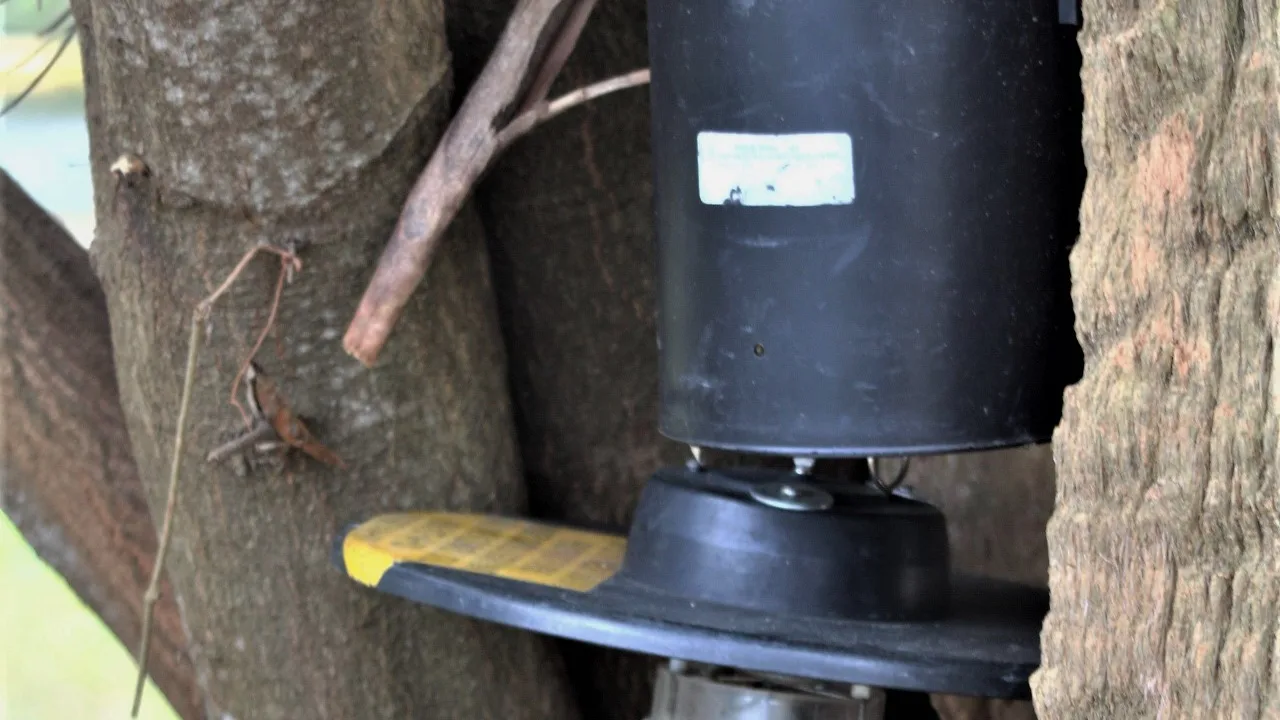
Pinellas has 80 locally acquired dengue cases, up 13 in a week, the state's latest report shows. Helicopters sprayed larvae treatment over parts of St. Pete on Thursday.
Pinellas County has recorded 80 locally acquired dengue cases this year, up from 67 a week earlier. The figure comes from the Florida Department of Health’s report for Oct. 25-31, the latest weekly count.
Updated Nov. 6: Helicopters sprayed Bti, a larvae treatment, over parts of St. Petersburg and Clearwater on Thursday, Nov. 5, Pinellas County Mosquito Control said in a release that day. Lee County Mosquito Control flew the treatments between 9 a.m. and 3 p.m. The state’s week 43 report puts Pinellas at 80 cases, Hillsborough at 407 and Pasco at 4, so 491 across the three Tampa Bay counties and 524 statewide. The county’s dengue page now describes a “mosquito-borne illness alert” for dengue and no longer says the county is under a state of local emergency. The county has posted no release ending or extending the emergency since the extension to Oct. 29.
Updated Nov. 1: The state health department’s Oct. 30 report counts 67 locally acquired dengue cases in Pinellas and 456 across the Tampa Bay area, according to the county’s dengue page. The page still says the county is under a state of local emergency for dengue. It gives no end date, and the county has posted no new extension since the one to Oct. 29. Helicopter treatments for mosquito larvae ran in parts of Clearwater on Friday, Oct. 30, the county said in a release that day. The county has not said whether flights over St. Petersburg have taken place; check the treatment map below. The free residential tire drop-off ended Oct. 30.
Updated Oct. 22: Burton extended the emergency again Thursday, to Oct. 29, the county said in its latest release. The state’s week 41 report puts Pinellas at 51 cases. Helicopter treatments for mosquito larvae over parts of St. Petersburg and Clearwater were delayed by high winds and will start no earlier than the middle of next week, the county said.
Updated Oct. 18: County Administrator Barry Burton extended the emergency on Oct. 15, to Oct. 22, the county said in a release that day. Mosquito Control has stopped taking routine mosquito complaints while crews focus on dengue.
Burton signed an earlier extension on Oct. 8, the county said in an earlier release. The Oct. 15 extension is set out in Resolution 26-85. He acts under authority the Board of County Commissioners gave him when it declared the emergency on Sept. 24.
The emergency lets Burton approve mosquito control spending quickly. It also opens the door to state reimbursement if money becomes available, according to the county.
How fast cases have grown
Pinellas had three locally acquired cases in mid-August. The total stayed in single digits until late September, then jumped to 13, 20, 37 and 51 within four weeks. It reached 67 in the week to Oct. 24 and 80 in the week to Oct. 31.
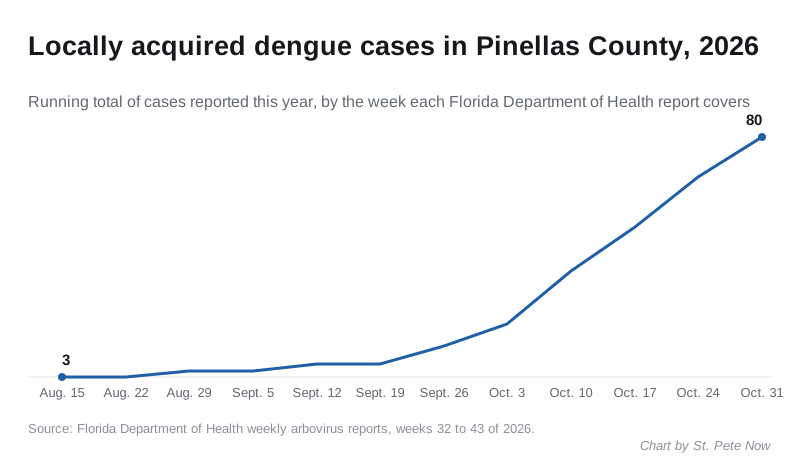
The counts come from the Florida Department of Health’s weekly arbovirus reports. Here is how the report for Oct. 25-31 compares with the report for Oct. 11-17, released Oct. 22:
| County | Cases to Oct. 17 | Cases to Oct. 31 |
|---|---|---|
| Hillsborough | 346 | 407 |
| Pinellas | 51 | 80 |
| Pasco | 4 | 4 |
| Florida total | 425 | 524 |
The state recorded 39 new locally acquired cases in the week to Oct. 31. Hillsborough still has about eight in 10 of the state’s cases.
On Oct. 22 the county put the three Tampa Bay counties at 401 cases, up 14% on the week before, and the state recorded 57 new cases that week. Earlier, the report for Oct. 4-10 listed 37 Pinellas cases and 368 statewide. Pinellas has also found West Nile virus in its sentinel chicken flocks, which the county called an early warning of possible human infections.
What the county is doing
Pinellas County Mosquito Control said it is running fogging trucks and a larviciding truck every day, weather permitting. Because viral activity is high, crews are not responding to routine mosquito complaints for now. Other steps:
- Late-night spraying: truck fogging may start as early as 11 p.m.
- Extra trucks: the county hired Clarke Mosquito Services for overnight treatments. Those trucks carry both Pinellas County and Clarke branding and may have out-of-state plates.
- Help from Lee County: Lee County Mosquito Control lent equipment.
- Helicopter larvae treatments: Lee County Mosquito Control helicopters spray Bti, a bacterium that kills only mosquito larvae and black flies, over designated parts of St. Petersburg and Clearwater, the county said Oct. 19. Flights ran over Clearwater on Oct. 30 and over parts of St. Petersburg and Clearwater on Nov. 5. They run between 9 a.m. and 3 p.m. and are low and noisy. The county said Bti is not harmful to people, pets or pollinators.
- Door-to-door crews: in treatment areas, staff in county uniforms with ID badges are asking to treat standing water on private property.
Completed and planned truck and aerial treatments are on the county’s treatment map.
Free tire drop-off ended Oct. 30
Old tires left outside collect rainwater and can breed thousands of mosquitoes in a season, the county said. From Sept. 28 to Oct. 30, Pinellas County Solid Waste waived the residential tire disposal fee. The waiver covered:
- up to four tires per resident, no more than 36 inches across
- rims may stay on; tires must be kept separate from other trash
- bring a valid driver’s license showing a Pinellas County address
- businesses still pay the normal fee
The waiver has ended, and the county has not announced an extension. Tire drop-off is at the Solid Waste Disposal Complex, 3095 114th Ave. N, St. Petersburg. It is open 6 a.m. to 6 p.m. Monday through Friday and 7 a.m. to 5 p.m. Saturday. Closed-toe shoes are required on site. For curbside pickup and bulk items, see our trash and recycling guide.
What it means for you
- Empty anything holding water around your home once a week: plant saucers, buckets, birdbaths, tarps and old tires.
- Wear light-colored long sleeves and closed-toe shoes outdoors.
- Use an EPA-registered repellent with DEET, picaridin, IR3535 or oil of lemon eucalyptus.
- Sign up at Pinellas.gov/Alert-Pinellas to be told when a helicopter treatment is scheduled for your neighborhood.
- If you think you have a mosquito-borne illness, call the Florida Department of Health in Pinellas County at 727-824-6932.
The county posts updates at Pinellas.gov/mosquito and explains dengue symptoms at Pinellas.gov/dengue.
Have your say